Saturday, April 15, 2023

52 Ancestors: Week 12, Membership

The prompt for Week 12 of Amy Johnson Crow's "52 Ancestors in 52 Weeks" is Membership. Since I should have written this during Women's History Month in March, let me mention three maternal ancestors and the organizations to which they belonged.

My maternal grandmother, Eugenia Marolewski, was a member of Mothers of World War II, Unit 125 from Immaculate Conception Church in South Chicago. For a few years she served as president of the group, as well as financial secretary of District 1. From newspaper items, it appesrs that this group was dedicated to supporting veterans. They visited local VA hospitals and provided cookies and gifts at Christmastime. The group welcomed mothers of those who served in World War II or Korea, as well as those who currently had children in the armed services. 

Grandma's sister-in-law, my grandpa Steve's sister Constance Norwich, once served as president of the American Legion Auxiliary South Chicago Unit 493. She was at one time national president of the Polish Legion of American Veterans, Ladies Auxiliary.

Grandpa and Grandma's daughter Henrietta (my aunt Hank) was a member of the Cadet Nurse Corps. A student at the Jackson Park Hospital School of Nursing, she joined the Corps in October 1944, and her service ended when she graduated in October 1947.

Friday, April 14, 2023

52 Ancestors, Week 11: Lucky

 I'm playing catch-up on "52 Ancestors in 52 Weeks," the project of a year's worth of writing prompts by Amy Johnson Crow. While everyone else will be on Week 16, I'm finally getting around to Week 11.

Week 11's theme is "Lucky." I don't especially recall any lucky talismans in my family. If my ancestors had any, I never knew about them. If they ever had any especially fortuitous luck, I never knew about that, either. 

The only luck I can think of is how lucky I am to know the stories I do know; to have found the records and mentions that I have found; and for the chance to tell their stories in my poor way.

While not precisely a lucky piece, there is something that I've kept on my refrigerator, as my dad did before me: these Round Tuits. I inherited a tendency to procrastinate. Procrastinators always put things off until such time as they can get around to it. I even acknowedged that trait by naming my blog Round Tuit Genealogy because I blogged so seldom. Sometimes it's been years between blog posts. 

So go ahead. You can keep your lucky penny, your rabbit's foot, your horseshoe. I'm actually blogging again. I've got a Round Tuit.


52 Ancestors, Week 10: Translation

I'm several weeks late in keeping up with Amy Johnson Crow's "52 Ancestors in 52 Weeks" challenge. While the project is entering Week 16, I'm catching up on Week 10: Translation.

Or, more accurately, "Lost in Translation."

Fifty percent of me is Polish. And I don't speak or understand a word of it. 

Thankfully, my second cousin does. Jay Orbik is a genealogist who's done all the work on our Orbik and Pyterek lines, and has taken the Orbik line into the 1600s. He's fairly fluent, and travels to Poland a couple times a year where he works with a group of genealogists there, Jamiński Zespół Indeksacyjny (JZI), on indexing and publishing projects. It was through this group that he's published two family histories so far: The Orbik Families from Tajno, and One Hundred Percent Polish: A South Chicago Family History.

So thanks, Jay, for all the work you've done! 

The Pytereks were from Gulcz, in west central Poland. Several members of the family came to Chicago shortly after the Great Chicago Fire in 1871. They lived in what was called the "Polish Downtown" anchored by St. Stanislaus Kostka Church, which was founded in 1867 by Rev. Vincent Barzynski. He performed the marriage of my great-great grandparents, Alexander Pyterek and Helena Murkowska, in that church in 1876. 

Chicago claims the largest population of Poles outside Poland itself. So the Polish neighborhoods of Chicago would have been fairly self-sustaining, with Polish-speaking residents patronizing Polish-owned stores and shops, attending one of a number of Polish churches, and whose children perhaps attended Polish parochial schools. They read Polish newspapers published in Chicago. In this setting, the Pytereks learned a new language. 

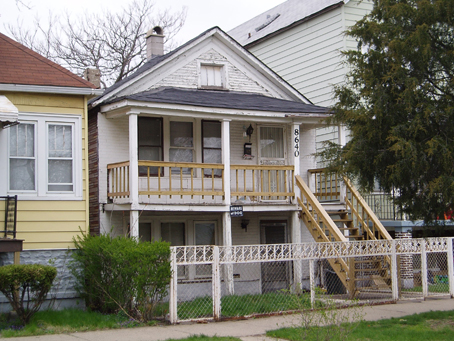
By 1900, Alexander, Helena, and their family relocated to South Chicago; the frame house they owned in the 8600 block of South Baltimore Avenue still stands. Alexander could read and write, and could speak English, according to the 1900 census. His brother Valentine (Walenty) appears on the voter rolls in Chicago in 1890, and is listed as having naturalized in 1878, so presumably he also could speak English. 

An upcoming exhibit at the Chicago History Museum, "Back Home: Polish Chicago" will open May 20. I hope to check it out and discover more about the Poles of Chicago, and my ancestors' contributions to it.


Monday, February 27, 2023

52 Ancestors, Week 9: Gone Too Soon

Infant mortality was a common occurence among our ancestors. With no modern vaccines, illnesses could affect whole families. How did young parents cope with the death of not just one, but two (or more) children? 

_____

Many of my paternal grandmother's family are interred at Old White Cemetery in Oskaloosa, Mahaska County, Iowa. In addition to great-grandma Iowa Hale Speed, her husband William Speed and her brother, Landon Hale, are there. So, too, are her son William Stotts, son of Iowa and her first husband, John Benton Stotts. 

William married Myrtle Spencer, daughter of J. W. Spencer and Lizzie Tarr, in 1904 in Oskaloosa. On 23 September of that year they welcomed their firstborn, a son, Joseph. Two years later, they welcomed another son, Charles.

What hopes and dreams they likely had of raising two strapping sons! But it was not to be. Joe died of dysentery July 31, 1906 at the age of 1 year, 10 months, and 7 days. His gravestone is engraved:

   Our Joe
   1904-1906

Charley died of cholera infantum on 16 August 1907 at the age of 1 year, 3 months and 13 days. Cholera infantum was an often fatal gastrointestinal disorder, often prevalent during summer months. Charley's gravestone reads:
Our Charley
1906-1907

Unfortunately, the person who created the Find A Grave memorial has incorrectly identified Joe and Charley as children of Iowa Hale Stotts Speed and her husband, William Speed, who are buried adjacent to the boys and whose stones are in the same design, likely paid for by William Stotts. I submitted edits for these stones, but as of today they are still linked to the wrong parents.
_______________

My paternal grandfather's family had its share of tragedy. I previously wrote about the death of Grandpa's uncle Charles Herrick, for whom Grandpa was likely named. Grandpa Charles's aunt, Jennie Herrick, and her husband James Osborn Mitchell lived in Canonsburg, Washington County, Pennsylvania. Jennie and James already had two children, Jean and Walter, when the couple welcomed twin sons — James Alexander Mitchell and his twin, William Herrick Mitchell — in mid-February of 1911. 

As with Charley Stotts in Iowa four years previously, cholera infantum struck. The twins were 5 months old. William died on 19 July 1911, and James on 23 July. A news item began, "Twice within a week death visited the home of Mr. and Mrs. James O. Mitchell, Highland Avenue, Canonsburg..." It ends by saying "Mrs. Mitchell was formerly Miss Jennie Herrick and she has been nearly prostrated by this double misfortune."

The twins are interred at Oak Spring Cemetery in Canonsburg. The Find A Grave Memorial for James lists him as James O., even though the obituary gives his name as James A., and his death certificate says James Alexander.
_____________

My maternal great-grandparents, Mary Pyterek and Stanislaus Orbik of South Chicago, Illinois, also were no strangers to infant death. 

After the births of Mary and Stanley's children, Harry, Eugenia, and Jennie, the couple welcomed a girl, Helen Josephine, in September 1908. Helen died the following August "of pneumonia (probably tubercular)."

The couple had a son, Alfred, in early September 1916. He died of "acute ileocolitis" the day after Christmas.

Both Helen and Alfred are buried at Holy Cross Cemetery in Calumet City, Cook County, Illinois.


_________________

This is a post for Week 9 of Amy Johnson Crow's initiative, #52 Ancestors in 52 Weeks.


Sunday, February 19, 2023

52 Ancestors, Week 8: I Can Identify

As I catch up on posting as part of Amy Johnson Crow's "52 Ancestors in 52 Weeks," the theme for Week 8 is "I can identify."

I only WISH I could identify...

  • all the photos in a photo album that belonged to my paternal grandparents. Most of the photos have no names. Are they kin, or merely family friends? (Tip: BE SURE TO identify the people in your photos and videos.)
  • the actual first name of my great-great-grandfather. Was he John Donley, John Donlon, John Patrick Donlon, or Patrick Donlon?
  • the actual first name of John's wife. Was she Katherine Kelley or Margaret Kelley?
  • the origin of another great-great grandfather, John Speed. He was from England, and DNA matches to his line seem to point toward an ancestry in Somerset. But John himself left no clues that I've found — yet.
  • the origin of 3x great-grandfather Henry Herrick, a coach driver who lived in Washington, PA. He was from New York, and that's all I know. (By the way, Henry, it'd be nice to know when you died. I'm just saying.)
  • whether Lydia Speed born in 1866 in Peoria County, Illinois, is the same Lydia who ran away from a girls' school in 1881, and whether they're both the same Lydia who married James Tucker in 1887 in Sangamon County, and who died in 1901 in Chicago.
That process — the investigation — is what I like about genealogy. Finding that little nugget, that "Aha!" moment, that discovery that leads to the genealogy happy dance when the pieces all slot into place. 


52 Ancestors, Week 7: Outcast

Week 7's theme for Amy Johnson Crow's "52 Ancestors in 52 Weeks" is Outcast.

My great-grandmother Iowa Hale Speed had a brother, Landon, nicknamed Landy. Landy was named for Iowa's grandfather, Landon Ballinger. Censuses from 1870-1900 indicate that he could read and write, and was eligible to vote. All extant Iowa State Censuses that ask about education indicate the same. However, the answers for the 1910 census questions "Whether able to read" and "Whether able to write," are both "No." Landon was employed mostly as a teamster, and also hauled coal. He never married.

A cousin of my dad's told us that her father would visit Landon at the County Home, and staff had to take his shoes because otherwise he would run away. When Landon died in 1937, a secondary diagnosis was dementia praecox, today known as schizophrenia.

__________

My Polish maternal grandfather had a brother, Bronislaw, whose name was Americanized to Barney. Barney's World War II Draft Card shows him as age 38, unemployed. His penmanship is very poor as compared to his older siblings, so the penmanship does not appear to be related to the amount of education he received. He did not marry.

In a newspaper article from 1951, Barney appealed to the South Chicago Police to give him a bunk for the night. He testified that he had no home, and said "I have a few relatives, but they have their families to take care of." He stated that he used to stay at a mission on 92nd Street. Three years before, he was beaten up in a local park, and his kneecap was broken. He stated that since then, he's spent seven or eight months of every year at the County Hospital. 

Barney died in 1957 of a heart ailment. 


52 Ancestors, Week 6: Social Media

The theme of Week 6 of Amy Johnson Crow's "52 Ancestors in 52 Weeks" is social media. I haven't found an ancestor on social media, but I did find a cousin. It was after posting to this blog (which I do VERY INFREQUENTLY) about my grandpa Herrick's first cousin Grant that several months later I was contacted by Grant's granddaughter, my third cousin Vicki. Vicki and I have met twice, and she showed me around my dad's birthplace — East Palestine, Ohio, which just a few weeks ago was the site of a major train derailment and toxic chemical leak.

The "52 Ancestors" theme can also encompass the social columns of our ancestor's newspapers. It was such a social tidbit that broke a brick wall on this line. The column mentioned that Mrs. C. P. Morgan went to East Palestine for a family funeral. Katherine Morgan (Vicki's great-grandmother) and Margaret Herrick McCabe (my great-grandmother) were sisters. While investigating whose funeral Kate attended, I found a surname of interest which then led to discovering Kate and Margaret's eldest brother, Robert Donlon — someone we'd not heard of before, although my father had told me about several of Margaret's other siblings.

So don't discount those social columns. By compiling and analyzing the social items pertaining to your  ancestor, you may be able to reconstruct a family unit that had been unknown to you.